

1 July 2026
1 September 2026

4 November 2026
13 November 2026

19 November 2024
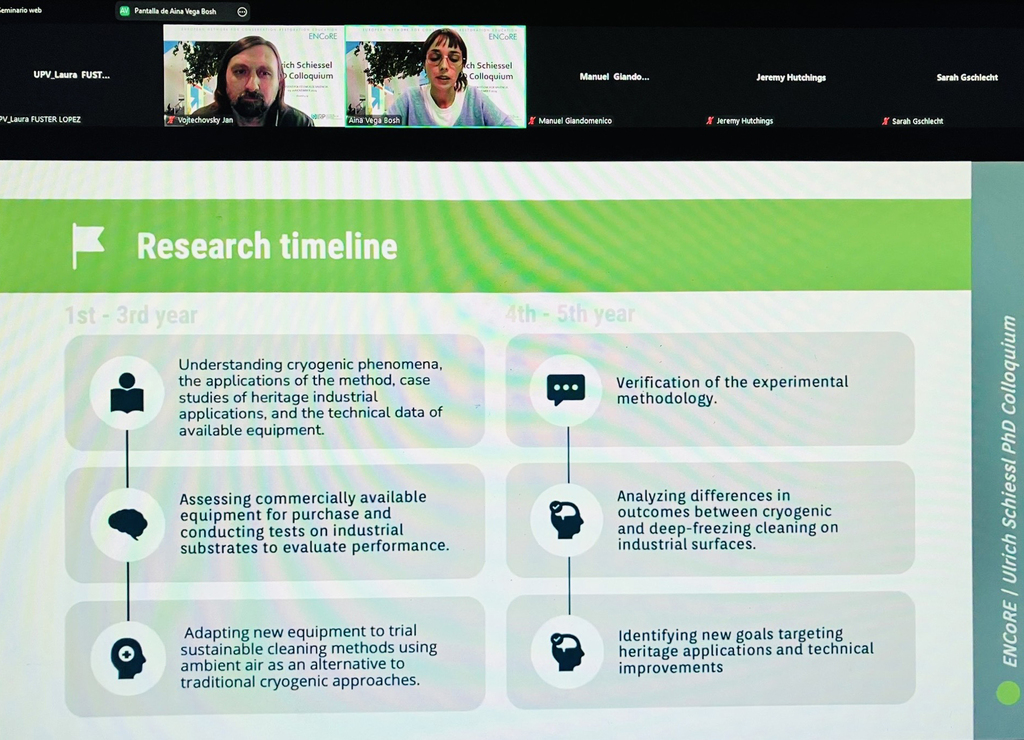
ECOTECULT presented its first results at the Fourth Ulrich Schiessel Doctoral Colloquium, held on 19–20 November 2024 at the Universitat Politècnica de València. Team member Aina Vega Bosch presented the study “Effect of Deep-Freezing on Sustainable Graffiti Removal from Non-Porous Substrates” , which represents the first phase of the project and forms the basis of her doctoral thesis.
The study explores the use of cryogenic cleaning with ambient air as a sustainable alternative to conventional CO₂ methods for removing graffiti from non-porous surfaces. Experiments conducted with the CMT research institute assessed thermal effects and informed parameter adjustments aimed at protecting heritage materials during treatment.
These results provide evidence on the feasibility of environmentally sustainable cryogenic cleaning and inform future applications in heritage conservation. Participation in the colloquium supports the project’s work on innovation and knowledge transfer in restoration and sustainability.
3 March 2025
ECOTECULT will be presented at Science × Art: Preserving Culture through Scientific Innovation on 7 March 2025 at the Spanish Cultural Centre of the Embassy of Spain in Washington, DC. Mª Pilar Bosch Roig of the Universitat Politècnica de València will discuss the project’s progress in developing sustainable heritage conservation technologies.
The event, organised by the Science Diplomacy Club with the Embassy of Spain and the National Gallery of Art, will bring together specialists in science and conservation to discuss technological innovation in the preservation of art and culture. In her talk, Pilar Bosch Roig will present early ECOTECULT results on using cryogenic and environmentally sustainable cleaning techniques in heritage conservation, with the aim of reducing environmental impact and improving treatment performance.
31 July 2025
On 30 July 2025, ECOTECULT, the project on sustainable technologies for cleaning, disinsecting and disinfecting cultural heritage, took part in the Second International Seminar on Natural Sciences, Conservation and Cultural Heritage, held at the Faculty of Chemistry of the Universidad de la República (Uruguay) as part of the National Meeting on Preventive Conservation and Risk Management.
Team member Aina Vega Bosch (UPV) presented “Adapting deep freezing as an advanced method for cleaning cultural heritage”, reporting ECOTECULT’s initial findings. The talk explored cryogenic cleaning as a sustainable and effective alternative for removing graffiti from non-porous surfaces, highlighting its low environmental impact and potential use in sensitive heritage settings.
Practitioners and researchers from several countries discussed natural science approaches to heritage conservation and management, with a focus on prevention, innovation and sustainability.
Watch the full event here
20 November 2025
On 20–21 November, ECOTECULT took part in the Other Narratives of the Family Album conference (ONAF 2025), held at the Universitat Politècnica de València.
Team member Sonia Garrido-García presented the study Towards a sustainable cryogenic cleaning methodology for cellulosic and photographic supports in the context of extreme weather events, developed with María Paula Wilches-Cuadros, Aina Vega-Bosch and Virginia Santamarina-Campos.
The work explores sustainable approaches to safeguarding family memories in climate emergencies.
1 February 2025
The quality plan for ECO-CRIOGENIA, the project on sustainable technologies for cleaning, disinsecting and disinfecting cultural heritage, sets out the methodological and regulatory framework for managing, implementing and monitoring project activities. It defines procedures, standards and controls for meeting the scientific, technical and social impact objectives within the time and resources allocated.
1 March 2025
The ECOTECULT communication and dissemination plan sets out a strategy for sharing results, transferring knowledge and communicating project impact. It aims to make scientific, technological and methodological advances in eco-cryogenics and other sustainable solutions accessible and applicable to researchers, heritage practitioners and related industries.
30 June 2025
The report sets out a methodological, regulatory and technical framework for the scientific validation of heritage treatments, with particular attention to cryogenic technologies. It analyses national, European and international regulations, technical standards and scientific literature to define consistent criteria for experiments, recording variables, evaluating results and comparing methods. It defines key terms, examines the applicability of regulatory frameworks to heritage and proposes guidelines for standardising the experimental phase, including traceability, validity and reproducibility. Standard data sheets support experimental recording, scientific quality, safety, environmental sustainability and technical consistency.
1 July 2026
This deliverable presents a preliminary theoretical screening of twelve fluids or gas mixtures for possible use in jet cleaning of heritage surfaces. Eleven alternatives are assessed against CO₂ as the reference technology. The fluids are CO₂, air, nitrogen, helium, neon, argon, krypton, xenon, ammonia, methane, ethane and nitrous oxide.
The comparison covers thermophysical properties calculated using CoolProp v6.4.2.0, potential thermal and mechanical transfer, expansion associated with phase change, direct environmental impact indicators, operational hazards and indicative purchase costs. It also considers potential risks to people, equipment and heritage materials.
This preliminary screening does not establish cleaning effectiveness or compatibility with cultural objects. CO₂ retains a specific advantage in systems that require solid particles and expansion on sublimation. Air and nitrogen are prioritised for subsequent work because they are non-flammable and have a low direct climate impact. Their assessment must also account for energy consumption and the characteristics of the compression, refrigeration and projection system. Argon is retained as a comparison fluid. The remaining fluids have limitations involving toxicity, flammability, oxidising capacity, climate impact, cost, supply or storage.
Final selection will require modelling the whole system and experimentally verifying effectiveness and safety on representative heritage materials.
ECOTECULT © 2025 by V. Santamarina-Campos is licensed under CC BY-NC-SA 4.0

